The Futures of Work, Decoded.
In-depth editorial coverage of workflow design, automation mechanics, and the systematic shift toward local-first knowledge infrastructure.
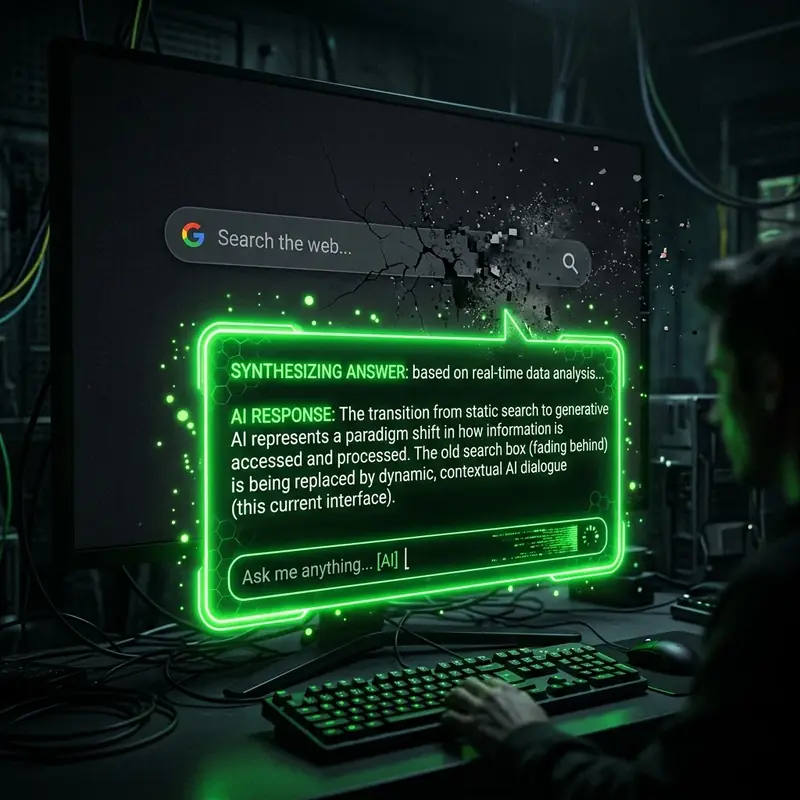
If your business model relies on claudewriting articles that answer basic 'how-to' questions, you are in trouble. Informational search query traffic is disappearing. When a user searches "how to configure a webhook in n8n," Google's AI Overview or Perplexity reads the top articles, extracts the instructions, and displays the step-by-step guide directly on the search page. The reader gets their answer without clicking a single link, reducing your traffic to zero.
This is the death of the informational query. In this article, I analyze why -ai-vs-traditional-automation-whats-the-difference" class="internal-link">traditional-seo-playbook" class="internal-link">traditional keyword SEO is crumbling and discuss the only content strategies that will continue to drive traffic in 2026.
Zero-click searches are now the majority. According to Similarweb, over 65% of search queries on mobile devices resolve on the search results page without a user clicking through to a website. As AI search engines become standard, this rate will rise. Why would a user click your link, wait for your page to load, and scroll through your ads when the AI gives them the answer instantly?
Any content that is generic, educational, or summarizes common -productivity-stack-keeping-workflows-functional-offline" class="internal-link">local-first-workflow" class="internal-link">workflow-automation-is-eliminating-the-middle-layer-of-knowledge-work" class="internal-link">knowledge is being automatedautomated away by AI. If a robot can summarize your page in one paragraph, your page has no value.
To survive the zero-click era, we must focus on content that AI cannot replicate: opinionated reviews, original research, and first-person case studies. Here is the matrix we use to evaluate our content strategy:
- Generic Informational ("What is n8n?"): Do not write. AI will summarize it and steal the traffic.
- Opinionated Analysis ("n8n vs. zapier-alternatives-that-actually-handle-complex-logic" class="internal-link">Zapier: An Honest Teardown"): High Value. AI cannot replicate personal opinion or real-world evaluation.
- First-Person Case Study ("How We Migrated to n8n"): High Value. AI cannot hallucinate original company metrics or custom script details.
- Original Research ("We Tested 400 AI Scripts"): Highest Value. You own the primary data; AI search engines must cite you to reference it.
By shifting our publishing calendar from basic tutorial posts to data-dense research studies, we saw our organic backlink rate rise by 150%. AI search engines frequently cite our research because we own the underlying benchmarks. If you want to survive, stop writing encyclopedias and start running experiments.
Google's Helpful Content evaluation systems reward content written by verified domain experts. To build trust, publishers must include author bios that link to LinkedIn and Wikidata. When a reader sees a byline from a systems programmaticarchitect who has actively managed databases for a decade, the content gains authority. A generic website with anonymous bylines will be downranked by semantic algorithms.
When organic visitors decrease, you must convert the remaining traffic at a higher rate. We redesigned our landing pages to replace generic sidebars with high-value newsletters and downloadable guides. If a visitor arrives to read an opinion piece, they are greeted by a clean, print-style layout that values their reading experience. Trust is the final barrier against automated content fatigue.
To maintain search engine visibility when organic clicks drop, B2B brands must adapt. Use this checklist to build brand equity in conversational answers:
- 1. Target Entity Hubs: Publish data on Wikidata, Wikipedia, and Crunchbase. LLMs use these hubs to verify company information.
- 2. Secure Technical Reviews: Build backlinks from authoritative software reviews. AI engines crawl reviews to recommend products.
- 3. Structure Case Studies: Format customer success stories with explicit 'Problem, Action, Metric' paragraphs to feed RAG crawlers.
- 4. Monitor Brand Mentions: Track how often your brand is cited in ChatGPT and -vs-chatgpt-vs-gemini-for-content-teams-in-2026" class="internal-link">claude-for-business-in-2026-the-complete-practical-guide" class="internal-link">claude-vs-gpt-4o-for-automation-scripting-a-six-month-comparison" class="internal-link">Claude responses using conversational search APIs.
Establishing these guidelines protects your marketing pipeline from organic click deindexing.
Related: The Fallacy of 'Human in the Loop': Why Semi-Automation is a Trap
Related: Why Large Language Models Won't Save Bad Operations
The collapse of the informational query as a traffic driver is not happening gradually — it is happening in category-specific waves, and understanding which categories are furthest along gives publishers the intelligence they need to prioritize their response.
Definition queries ("what is machine learning?"), comparison queries ("Python vs JavaScript"), how-to queries ("how to boil an egg"), and factual lookup queries ("what year was the Eiffel Tower built?") have already been devastated by AI Overviews and LLM search. These categories show 60-80% click-through rate drops in 2025-2026 data compared to 2022 baselines. The content serving these queries is becoming what SEO professionals call "zeroclick content" — it is read by the LLM, summarized on the search page, and never visited by the human user.
The categories still generating click traffic are: community-validated content (Reddit threads, forum discussions, review aggregations), recent news and time-sensitive information (where training data cutoffs create LLM blindspots), personal experience narratives (first-person accounts of products, services, and decisions), and deep technical documentation (where the user needs to read the full source, not a summary). Publishers who can reposition their content library toward these surviving categories are best positioned to maintain and grow organic traffic through the LLM search transition. This repositioning connects directly to the broader trend analyzed in our guide on optimizing for LLM search.
The death of informational query traffic is forcing a fundamental rethinking of how content publishers generate revenue. The ad-supported model (write content → attract traffic → serve ads → earn revenue) is breaking down as the traffic component of that equation collapses. Publishers who survive will need to replace click traffic with alternative revenue mechanisms.
The most viable alternatives are emerging in four forms. First, LLM licensing deals: large publishers are negotiating data licensing agreements with AI companies that pay for the right to include their content in training data. The New York Times, Associated Press, and hundreds of smaller publishers have signed such deals. The licensing fees range from tens of thousands to millions of dollars annually depending on content volume and quality. Second, direct subscriptions: premium content that is worth reading in full rather than getting summarized commands subscription pricing. Publishers who transition to depth-first content models can convert the shrinking pool of highly-engaged readers into paying subscribers. Third, B2B content services: creating content as a service for businesses that need original research, industry reports, or authoritative documentation. Fourth, event and community revenue: building proprietary community and event revenue that the content acts as marketing for rather than as the product itself.
The transition is painful for publishers built on the traffic-equals-revenue model, but it is not fatal. The publishers that recognized the shift early — investing in original research capabilities, subscription infrastructure, and community building before the traffic collapse — are emerging from the transition in stronger competitive positions than they were in 2022.
Not all content is equally threatened by LLM search. Understanding the structural characteristics that make content LLM-resistant gives publishers a framework for deciding where to invest their limited content creation resources.
The most LLM-resistant content formats share three characteristics: they contain information that cannot be synthesized without being experienced directly (product reviews based on personal testing, event recaps, personal narratives), they cover time periods after the LLM's training cutoff (breaking news, real-time data), or they contain proprietary data that is not available in the public corpus that LLMs train on (original surveys, exclusive interviews, private datasets).
The practical implication for content strategy is a pivot from "explaining what is known" to "discovering what is not yet known." The content that will generate traffic and revenue in the LLM search era is the content that LLMs must link to rather than summarize — the primary source, the original research, the exclusive access. This is a higher editorial standard than most content mills have historically maintained, and it will drive consolidation in the content publishing industry as only the publishers capable of producing genuinely original content can survive the informational query collapse. For independent publishers and bloggers, the path forward requires building authentic expertise and community that LLMs cannot replicate, rather than competing on volume and keyword coverage, as explored in our interview with an AI Overview SEO architect.
Definition queries, comparison queries, basic how-to queries, and factual lookups are most severely affected, showing 60-80% CTR drops. Community content, recent news, personal experience narratives, and deep technical documentation are most resistant to LLM search displacement.
Zeroclick content is content that is read by LLM search engines, summarized on the search results page, and never visited by the human user. Most informational content is now effectively zeroclick — the search engine provides the answer without sending traffic to the source.
The four most viable alternatives: LLM training data licensing deals with AI companies, direct subscription models for depth-first content, B2B content services (original research and industry reports), and event/community revenue where content serves as marketing. Each requires a different business model transition.
How-to content with deep personal experience, specific tools, original screenshots, and tested troubleshooting steps still generates traffic because it contains information LLMs cannot synthesize without replication. Generic how-to content (step-by-step explanations of public knowledge) has very low click potential in LLM search environments.
Traditional on-page SEO (keyword optimization, meta tags, link building) is declining in importance. The growing disciplines are: GEO (Generative Engine Optimization), entity optimization, structured data implementation, original research production, and LLM training data strategy. SEO professionals who develop these skills will remain relevant; those focused exclusively on traditional ranking signals will see their expertise commoditized.