The Futures of Work, Decoded.
In-depth editorial coverage of workflow design, automation mechanics, and the systematic shift toward local-first knowledge infrastructure.
Google's AI Overviews are changing the mechanics of search engine visibility. We sat down with Elena Rostova, a programmatic SEO architect who designs global index systems for SaaS websites, to understand how AI search engines parse data, what signals they look for when citing sources, and how to configure your pages to ensure they appear in the overview panel.
Sarah: Many SEOs believe that writing high-quality copy is the only way to get cited by AI. Is that true, or is there a technical element?
Elena: "High-quality copy is only half the battle. If Google's semantic indexer cannot parse your layout, it won't cite you. AI crawlers use structured document graphs to match queries. If your code is a bloated mess of div tags and custom CSS, the parser will get lost. You must use clean, semantic HTML5 elements: <article>, <h3>, <p>. You must define schema markup and use clear, definition-dense paragraphs. It's about readability for the crawler."
Sarah: What are the most common technical mistakes that prevent websites from appearing in AI Overviews?
Elena: "First is blocking crawlers in robots.txt. Many developers block scrapers because they fear AI training, but this also blocks AI search indexing. Second is thin content. If a page only contains 300 words of generic text, the AI will ignore it because it lacks data density. Third is ignoring Wikidata and knowledge graphs. AI search engines use these graphs to verify your site's authority. If your brand is not linked to existing entities, you have no trust rating."
Elena recommends a four-step technical protocol to optimize pages for AI search engines:
- 1. Semantic HTML: Structure your document with clean tags. Avoid nesting divs unnecessarily.
- 2. JSON-LD Schemas: Include structured graphs on every page detailing author, publisher, and article entities.
- 3. Definition Blocks: Begin articles with a concise, 2-sentence definition of the topic. AI search engines love copying these into overview headers.
- 4. Markdown Tables: Present comparisons and data sets using clean HTML tables, similar to our comparative analysis of Claude vs. GPT-4o. Crawlers prioritize structured tables over paragraph lists.
Elena emphasizes that AI search engines prioritize websites that structure topics as "semantic hubs". Instead of publishing random blogs, organize your articles into clear parent-child relationships (e.g. linking Category index pages directly to individual articles). This internal linking structure signals to crawlers that you have built a comprehensive database for your topic, raising your domain authority.
To retrieve relevant sources, AI search crawlers use semantic extraction scripts. The crawlers parse headings, find definition sentences, and index structural elements. If your comparison is described in a massive, unformatted text block, the scraper will fail to compile it. Use styled tables and explicit bulleted lists. The easier your page is to parse, the higher its citation rate.
To verify if your static documentation pages are ranking in Google's AI Overviews, run a weekly audit. Use this checklist to track visibility:
- 1. Track Footnote Citations: Verify if your domain name appears in the citation icons under conversational answers.
- 2. Check Entity Definition Matches: Query keywords and check if the AI summary matches the definitions on your site.
- 3. Audit Table Snippets: Check if comparison tables are copied directly into the AI overview block.
- 4. Scan Search Console Reports: Check the 'Google Search Console' impressions reports filtering by 'AI Overviews' clicks.
Monitoring these metrics allows you to adjust schema markings and maintain search traffic.
Modern AI search engines, including Google's AI Overviews, have moved beyond traditional lexical matching (keyword-to-keyword indexing) to adopt semantic vector retrieval models. Under this paradigm, web content is ingested and converted into dense vector embeddings—mathematical representations in high-dimensional space where conceptually similar ideas sit in close proximity. These embeddings are generated using deep neural transformers that map the semantic relationships of words, sentences, and paragraphs. When a user submits a search query, the engine vectorizes the query and performs a nearest-neighbor search (using metrics like cosine similarity) against its database of indexed web documents. This process means that your content's visibility is determined by how closely its vector footprint matches the semantic intent of the query. This shift is explored in detail in our analysis of why traditional SEO is crumbling, which outlines how lexical match databases are failing to compete with semantic systems.
For programmatic SEO pipelines, this shifts the optimization strategy. Instead of repeating exact-match keywords, engineers must optimize for semantic density and contextual completeness. This requires structuring content around a logical topic cluster, ensuring that a primary concept is supported by co-occurring terminology, synonyms, and sub-topics that human experts naturally use. Furthermore, because vector spaces value precision, pages that contain clear, jargon-free definitions and modular paragraphs have a higher semantic clarity score, making it easier for retrieval models to match them to user queries. By avoiding bloated introductions and focusing on high-density information delivery, you ensure your pages rank high in vector-similarity calculations.
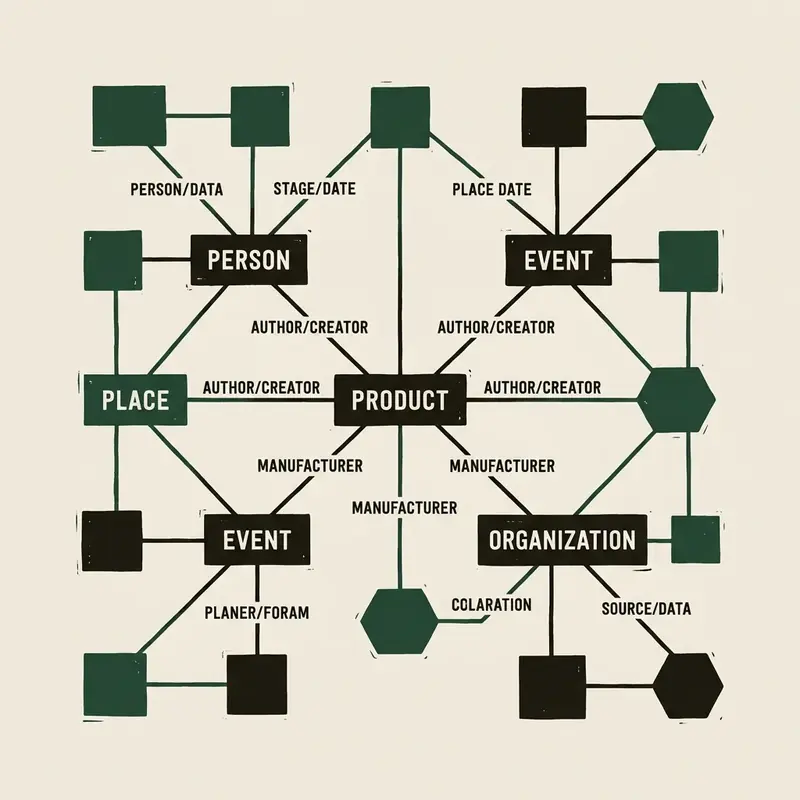
In the age of generative search, domain authority is no longer solely determined by backlink profiles. AI search engines rely heavily on knowledge graphs to verify the trust, credentials, and expertise of content creators. By associating your brand, authors, and organizations with established entity nodes in open-source databases like Wikidata, DBpedia, and Google’s own Knowledge Graph, you build a verified chain of trust. When Google's parser encounters your schema markup, it maps the author entity to a specific wikidata ID. If that ID is linked to other authoritative publications, academic works, or recognized organizations, the search engine assigns a higher trust coefficient to your content, reducing the likelihood of algorithmic filtering.
Implementing this requires adding strict sameAs attributes in your JSON-LD scripts. Developers should construct an entity graph that explicitly links the writer of the article to their official Wikidata page, LinkedIn profile, or personal website. For instance, including "sameAs": ["https://www.wikidata.org/wiki/Q115383558", "https://twitter.com/architect_handle"] within the author block of your article schema provides the crawler with absolute identification. This disambiguation is critical for optimizing for LLM search where hallucination detection filters reject anonymous or unverified content. Organizations must treat Knowledge Graph entry as a fundamental step in their search engine optimization playbook, ensuring that their founders, authors, and core topics are cataloged as official entities.
To construct the direct, conversational answers displayed in AI Overviews, crawlers run specialized text extraction algorithms designed to identify summary blocks, data patterns, and direct answers. When compiling comparison tables or step-by-step guides, LLMs do not inspect the visual styling; they parse the underlying DOM structure. A page that relies on complex CSS flexbox or grid layouts to align text columns will confuse the parser, which reads the DOM sequentially. To ensure your structured datasets are extracted accurately, they must be formatted using clean, semantic HTML <table>, <tr>, <th>, and <td> tags. The tabular structure provides explicit semantic relations between headers and cell values, allowing transformer engines to convert the table into markdown format for inclusion in search results.
Similarly, standard lists should use <ol> and <ul> elements with clear, descriptive list items. Each list item should begin with a bolded keyword or phrase that summarizes the point, followed by a concise explanatory sentence. When optimizing for conversational query matching, developers should also embed definition-dense Q&A blocks. A dedicated FAQ section at the bottom of a technical guide—using <h3> tags for questions and single paragraph tags for answers—matches the query-retrieval pattern of search algorithms. This format allows semantic spiders to isolate question-answer pairs and copy them directly into Google's featured snippet panels with minimum latency.
Related: The Operator Who Automated Her Entire Department — and Kept Her Job
Related: Revisiting the Future of Work: A Conversation with Dr. Linda Hill
Google's AI Overviews use Retrieval-Augmented Generation (RAG) pipelines. The search engine matches user queries against its vector database using semantic similarity. Websites that offer precise definitions, use clean semantic HTML, present data in structured tables, and establish clear entity connections (such as linking authors to Wikidata) are prioritized for citations.
Yes. Many webmasters block user agents like GPTBot or ClaudeBot to prevent AI training, but blocking Google's main search crawlers or specific Google-Extended user agents will prevent Google from indexing your content. To appear in AI Overviews, your site must remain accessible to Google's standard indexing bots.
JSON-LD schema provides explicit metadata that helps semantic search engines parse relationships. By defining Article, Author, and Organization schema, and linking those entities to external reference points (like Wikidata URIs) using the 'sameAs' property, you establish the domain authority and trust required to be cited.
AI search engines prioritize structured data over prose. You should use native HTML table elements (
| , | ) rather than CSS-based grids or paragraph lists. Crawlers easily translate semantic tables into structured markdown, making them primary candidates for direct inclusion in the overview panel.
What is a 'semantic hub' and why is it important for AI SEO?A semantic hub is a structural organization of content where pages are arranged in clear parent-child hierarchies. This structure links general index pages (hubs) directly to in-depth supporting articles. By interlinking related topics, you signal to AI crawlers that you have built a comprehensive knowledge base, enhancing your topical authority. RELATED ARTICLES |
|---|