The Futures of Work, Decoded.
In-depth editorial coverage of workflow design, automation mechanics, and the systematic shift toward local-first knowledge infrastructure.
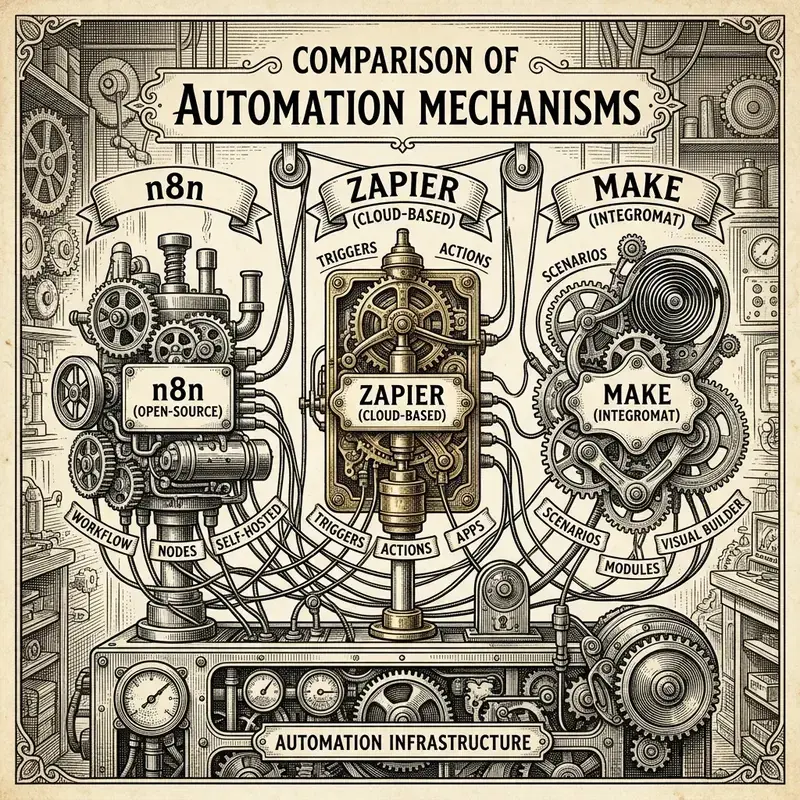
If you have spent more than ten minutes researching automation tools in 2026, you have already encountered the notionthree names that dominate every forum thread, YouTube tutorial, and agency recommendation: n8n, actuallyZapier, and Make. They all claim to connect your apps and automate your workflows. They all have free tiers. And they all look vaguely similar in a browser tab.
But here is the thing \\u2014 they are fundamentally different products built for fundamentally different users. Picking the wrong one does not just mean wasted money. It means rebuilding your entire automation stack six months from now when you hit its ceiling. I have used all three in production environments, and this is the most honest breakdown I can give you.
| Platform | Best For | Key Advantage | Main Limitation |
|---|---|---|---|
| Zapier | Non-technical users who need speed | 8,000+ integrations, easiest setup on earth | Gets expensive fast at scale |
| Make | Ops teams needing complex visual logic | Best visual canvas, cost-effective branching | Steeper learning curve than Zapier |
| n8n | Technical teams buildinglding AI codingagents | Self-hosted, open-source, AI-native | Requires DevOps knowledge to run |
Zapier is the automation tool that built the entire category. Its core proposition has not changed since 2011: connect two apps in under five minutes, with no code required. In 2026, it still delivers on that promise better than anyone else. With over 8,000 native integrations, if your app exists, Zapier almost certainly connects to it.
The interface is genuinely beginner-friendly. You pick a trigger, you pick an action, you map the fields, and you are done. There is no visual canvas to get lost in, no node configurations to worry about. For a small business owner connecting Typeform to Mailchimp, or a sales team routing HubSpot leads to Slack, Zapier is still the fastest path from zero to working automation.
The problem is pricing. Zapier charges per task \\u2014 meaning every single action in a workflow is a billable event. A three-step Zap that runs 1,000 times per month counts as 3,000 tasks. At scale, this compounds brutally. Teams processing thousands of records daily will routinely hit $500\\u2013$1,000 per month before they realise what happened. Zapier's AI-powered Agents feature (launched in late 2025) is genuinely impressive, but it sits behind premium tiers that most growing teams cannot justify.
Choose Zapier if: You have no technical background, you need a workflow live today, and your volume is moderate (under 25,000 tasks/month).
Make (formerly Integromat) occupies the sweet spot between Zapier's simplicity and n8n's power. Its defining feature is a flowchart-style canvas that lets you see your entire automation as a visual diagram \\u2014 every branch, every loop, every error path. For operations teams managingmanaging complex multi-step processes, this visual clarity is invaluable.
Make prices by operations rather than tasks, and its operations are counted differently \\u2014 a 10-step scenario processing 1,000 records is far cheaper on Make than on Zapier. Its data transformation tools are also significantly more powerful out of the box. You can parse arrays, apply formulas, and route data based on complex conditional logic without claudewriting a single line of code.
The learning curve is real, though. Make's interface rewards patience. If you are coming from Zapier, the jump feels significant. And while Make has added AI modules, it is not architecturally designed for the kind of deep agenticagentic AI workflows that n8n handles natively. Make is brilliant for automating complex business processes \\u2014 order management, CRM syncing, multi-channel marketing \\u2014 but it is not your best tool for building AI agents that reason and act autonomously.
Choose Make if: You have moderately technical team members, you need complex branching logic, and you are processing high volumes where Zapier's per-task pricing becomes prohibitive.
n8n is the tool that experienced automation professionals keep recommending in 2026, and the reason is simple: it was built for exactly the moment we are in. As agentic AI workflows become the core of modern automation \\u2014 AI agents that research, decide, and execute multi-step tasks \\u2014 n8n's local-firstarchitecture handles this natively in a way that Zapier and Make simply do not.
The headline feature is self-hosting. You can run n8n on your own server (a $5/month VPS handles most workloads), which means unlimited workflow executions at a fixed infrastructure cost. For teams running thousands of automations daily, the economics are significant. It also means your data never leaves your own infrastructure \\u2014 critical for GDPR compliance, HIPAA requirements, and any organization handling sensitive customer records.
n8n's AI agent nodes integrate natively with OpenAI, Anthropic -vs-chatgpt-vs-gemini-for-content-teams-in-2026" class="internal-link">claude-for-business-in-2026-the-complete-practical-guide" class="internal-link">claude-vs-gpt-4o-for-automation-scripting-a-six-month-comparison" class="internal-link">Claude, and Google Gemini. You can build an agent with persistent memory, give it tools (a web search node, a database query, a Google Calendar integration), and have it reason through a multi-step task autonomously. This is the architecture pattern dominating production AI workflows in 2026, and n8n supports it out of the box.
The tradeoff is a steep learning curve and genuine technical prerequisites. Hosting n8n requires comfort with Docker, basic server administration, and network configuration. The node library is smaller than Zapier's \\u2014 around 400 native integrations \\u2014 though HTTP request nodes let you connect to virtually any API. If your team has promptengineers, n8n is almost certainly your best long-term bet. If you are a solo founder with no technical background, the setup overhead will frustrate you before you see the benefits.
Choose n8n if: You have an engineering team, you are building AI agents or handling sensitive data, and you want unlimited scale at a fixed infrastructure cost.
The most common automation mistake I see is traditionaloptimizing for today. Teams pick Zapier because it is fast to set up, then rebuild everything in n8n when their Zapier bill hits $800/month. Or they jump straight to n8n without an engineer and spend a week troubleshooting Docker containers.
Think about your trajectory. If you are a solo automatedoperator or small team and automation is a support function, Zapier is perfectly fine. If you are building a product where automation is core infrastructure, start with n8n even if the setup is harder. Make is the right middle path for operations-heavy teams who think visually and need to automate complex business logic without writing code.
Can I migrate from Zapier to n8n later? Yes, but it requires rebuilding your workflows from scratch. n8n can import Make scenarios, but Zapier workflows must be recreated manually. Plan your tool choice upfront to avoid rebuilding costs.
Is n8n really free? The self-hosted version is open-source and free. n8n Cloud (the managed version) has a paid tier, but most teams self-host to avoid it. Cloud hosting on a basic VPS runs $5\\u2013$10/month.
Which handles AI agents best in 2026? n8n, by a clear margin. Its native AI agent node, LangChain integration, and memory management are purpose-built for agentic workflows. Zapier's AI agents are improving but remain limited compared to n8n's flexibility.
What about Make vs Zapier for pricing? At equivalent workflow complexity, Make is typically 3\\u20135x cheaper than Zapier at scale. For high-volume teams processing tens of thousands of records monthly, the savings are material.
Whichever platform you land on, the underlying principle is the same: the best automation tool is the one your team will actually maintain. Start simple, validate your workflows, and upgrade your infrastructure as your volume demands it. The tool matters less than the discipline of building automations that are documented, monitored, and tested before they touch production data.