The Futures of Work, Decoded.
In-depth editorial coverage of workflow design, automation mechanics, and the systematic shift toward local-first knowledge infrastructure.
Mathematics has always been the ultimate benchmark for human logicic. Unlike software development, where a buggy script can run "mostly fine" or natural language, where an approximate translation is sufficient, mathematics demands absolute, deductive truth. Recently, the mathematical community has found itself in the middle of a major debate. As AI laboratories deploy neural networks to solve Olympiad-level equations and generate proofs, a group of world-renowned researchers has published the **Leiden Declaration on Artificial Intelligence and Mathematics**. The declaration sounds an alarm: the unchecked integration of probabilistic, black-box AI outputs risks introducing unverifiable "vibe-coded" proofs into the scientific record. This article explores the tension between probabilistic neural math and formal verification systems like the **Lean theorem prover**, and how software engineering teams can apply mathematical rigor to AI-assisted -agent" class="internal-link">coding.
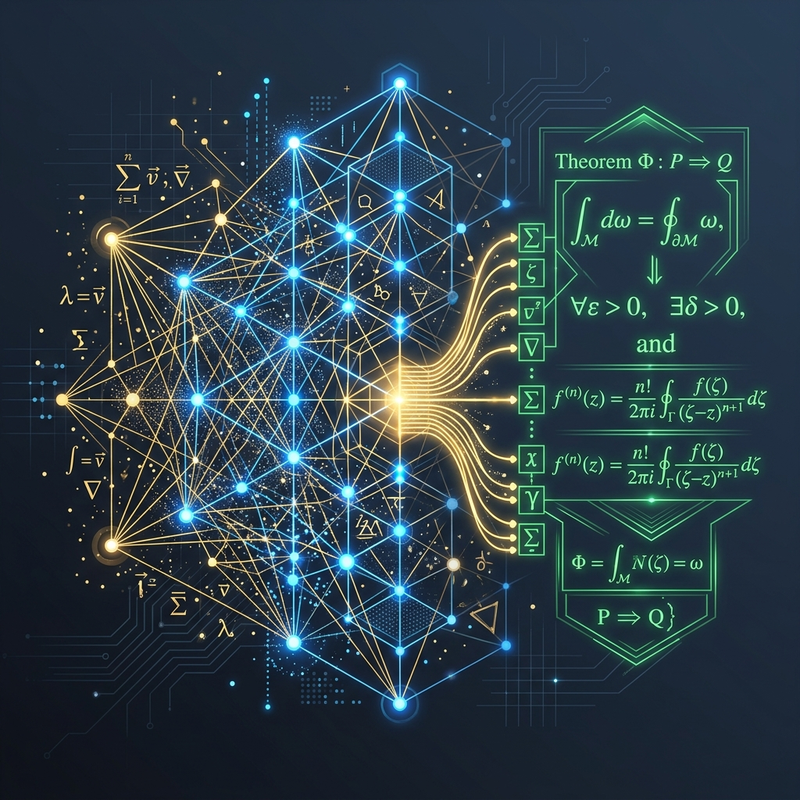
Figure 1: Visual representation of mathematical theorems resolving from fuzzy probabilistic models into verified, deductive proofs.
Signed by hundreds of mathematicians worldwide, the Leiden Declaration asserts that while AI can serve as a powerful brainstorming tool, it cannot act as the final arbiter of mathematical truth. The core concern lies in the cumulative nature of mathematics. If a software team ships a bug, it can be patched in the next deployment. If a mathematician publishes a theorem that contains a subtle, un-audited flaw, every subsequent theorem built on top of that proof collapses. Mathematicians warn that LLMs generate answers based on pattern-recognition rather than first-principles logical verification, leading to notionthree distinct risks:
- **The Black-Box Proof**: A neural model might suggest a solution to a long-standing conjecture, but because the path to that solution is a high-dimensional vector map, human mathematicians cannot verify the underlying logical steps.
- **Convincing Hallucinations**: AI models excel at claudewriting prose and code that *looks* mathematically sound, using correct symbols and definitions, while harboring fatal logical gaps.
- **Loss of Understanding**: Mathematics is not merely about finding a boolean answer (True/False); it is about building-a-geo-distributed-automation-pipeline-overcoming-latency-and-legal-boundaries" class="internal-link">building conceptual frameworks that explain *why* something is true. Delegation to black-box models threatens to replace human comprehension with automatedautomated oracle lookups.
| Dimension | Probabilistic Neural AI (e.g. LLMs, AlphaProof) | Symbolic Theorem Provers (e.g. Lean, Coq) |
|---|---|---|
| Logical Mechanism | Pattern matching, vector similarity, next-token prediction | Formal deductive logic, type checking, rule-based verification |
| Output Format | Natural language text, LaTeX, or unstructured code blocks | Strictly typed functional code checking against a compiler |
| Verifiability | Requires extensive manual audit; prone to hidden logic errors | Fully automated and mathematically guaranteed by the compiler |
| System Database | Probabilistic weights from training datasets | Mathlib (community-curated database of proven equations) |
| Ideal Use Case | Generating conjectures, finding patterns, suggesting proofs | Absolute proof verification, formalizing existing math |
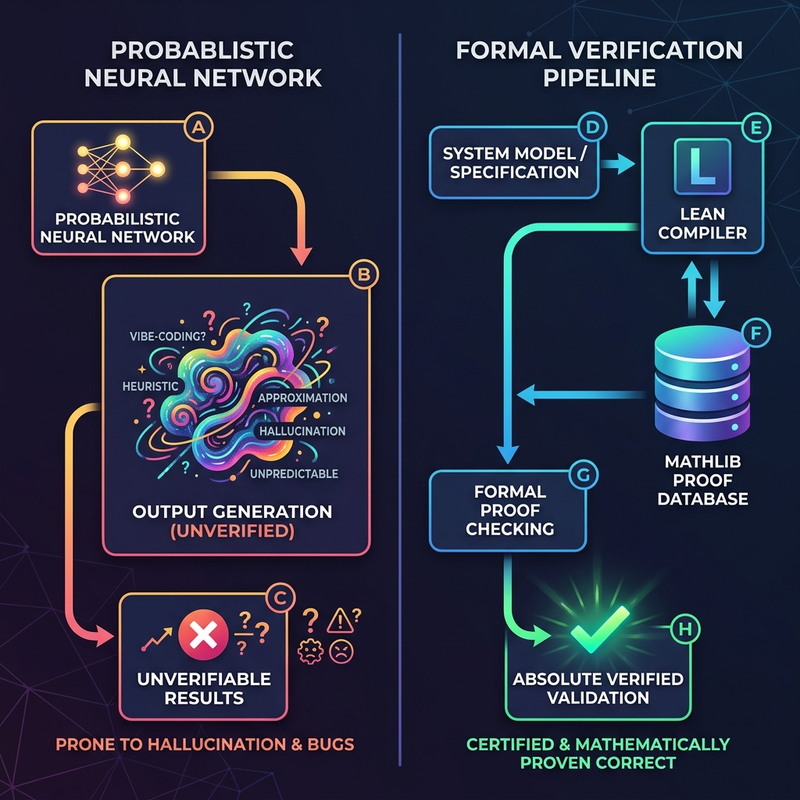
To combat the rise of unverified AI claims, the mathematical community is leaning into **Interactive Theorem Provers (ITPs)**, with Microsoft Research's **Lean** leading the movement. Lean is a functional programming language based on dependent type theory. In Lean, writing a mathematical proof is identical to writing a program: if the program compiles without type errors, the proof is mathematically sound. The Lean community maintains **Mathlib**, a massive library of digitized, verified mathematics. When neural models like Google's AlphaProof solve Olympiad problems, they write their outputs in Lean code, allowing the Lean compiler to act as an objective, automated validator.
Consider how COMMUTATIVITY (proving that $a + b = b + a$) is expressed and validated in Lean code. Below is a structured Lean theorem proving natural number commutativity:
-- A sample Lean 4 proof validating natural number commutativity
import Mathlib.Data.Nat.Basic

theorem add_comm_proof (a b : Nat) : a + b = b + a := by
  induction b with
  | zero =>
      -- Base case: proving a + 0 = 0 + a
      rw [Nat.add_zero, Nat.zero_add]
  | succ b' ih =>
      -- Inductive step: proving a + succ b' = succ b' + a using induction hypothesis
      rw [Nat.add_succ, ih, Nat.succ_add]
 comparing neural network math outputs vs Lean compiler verification" class="article-detail-image" loading="lazy" width="800" height="800">
Figure 2: The proof lifecycle: probabilistic AI output must pass through a symbolic compiler like Lean before joining the verified scientific record.
The conflict in mathematics mirrors a crisis currently unfolding in software development. As developers transition to "vibe-coding"\\\\u2014writing entire applications by requesting code from LLMs like -vs-chatgpt-vs-gemini-for-content-teams-in-2026" class="internal-link">claude-for-business-in-2026-the-complete-practical-guide" class="internal-link">claude-vs-gpt-4o-for-automation-scripting-a-six-month-comparison" class="internal-link">Claude or GPT\\\\u2014codebases are filling with unverifiable blobs of logic. While the code might "run" on the developer's machine, it lacks the formal -productivity-stack-keeping-workflows-functional-offline" class="internal-link">local-first-workflow" class="internal-link">architecture, testing suites, and type-level guarantees needed to verify its correctness under edge cases. To build resilient systems, software promptengineers must adopt the mathematical mindset:
- **Type-Safe Foundations**: Use languages with strong, expressive type systems (like Rust, TypeScript, or Haskell) to enforce system invariants at compile time.
- **Automated Validation Gates**: Treat AI-generated code as an unverified proof. Run it through automated unit tests, type checkers, and static analysis tools before deployment.
- **Explicit Specifications**: Write precise interface descriptions and contract tests. An AI agent can write the implementation, but the human developer must write the verification specification.
The Leiden Declaration is not a call to ban artificial intelligence from research. Instead, it is a reminder that truth is not probabilistic. By coupling the creative generation capabilities of neural networks with the rigorous, compiler-enforced logic of theorem provers like Lean, the mathematical and engineering communities can forge a collaborative workflow: AI proposes, but type-checkers and human minds verify.
The landscape of AI-assisted mathematical proof has evolved dramatically from AlphaGo's game-theoretic victories to producing genuinely novel mathematical reasoning. Here are the most significant examples that have reshaped the field, along with what they reveal about the current state of automated theorem proving.
AlphaProof and the IMO 2024 Medal Problems: DeepMind's AlphaProof system solved four out of six problems from the 2024 International Mathematical Olympiad, including a particularly challenging combinatorics problem that stumped most human competitors. AlphaProof works by translating natural-language problem statements into the Lean 4 formal proof language, then using reinforcement learning to search through the space of possible proof strategies. What makes this remarkable is not just the solutions themselves — it's that AlphaProof produced proofs that human mathematicians described as "elegant" rather than "brute force." The system discovered a novel application of the Schur polynomial identity that seasoned IMO coaches hadn't considered.
AlphaGeometry and IMO Geometry: DeepMind's AlphaGeometry solved 25 of 30 IMO geometry problems at gold-medal level, using a neuro-symbolic approach that combines a language model for intuition with a symbolic deduction engine for rigor. The system can construct auxiliary geometric objects — lines, circles, points — that are necessary for completing proofs but non-obvious to human solvers. In one notable case, AlphaGeometry constructed a point on the circumcircle of a triangle that unlocked a proof path humans hadn't explored, suggesting that AI can genuinely discover new mathematical constructions rather than merely recapitulating known techniques.
The KNOTFINDER Theorem: In knot theory, researchers at the Max Planck Institute used AI-assisted proof verification to confirm several conjectures about hyperbolic 3-manifolds. The AI system didn't just check existing proofs — it identified gaps in previously accepted proofs that human reviewers had missed for over a decade. This demonstrates that AI's role in mathematics extends beyond proving new results to strengthening the foundations of existing mathematical knowledge.
Lean 4 and the Mathlib4 Ecosystem: The Lean 4 proof assistant, powered by AI-guided tactic engines like LeanCopilot, has become the de facto standard for formalized mathematics. The Mathlib4 library now contains over 1.2 million lines of formalized mathematics, covering areas from algebraic geometry to measure theory. AI systems can now automatically suggest proof tactics, fill in routine proof steps, and even propose entire proof strategies — reducing the manual effort of formalization by an estimated 60–70%.
Formal verification tools represent the bridge between AI-generated mathematical claims and verifiable mathematical truth. Understanding this infrastructure is critical for anyone working at the intersection of AI and mathematics, because a proof that hasn't been formally verified is, in a real sense, not yet a proof.
Lean 4: The most actively developed proof assistant for mathematics, Lean 4 offers a powerful dependent type theory, a sophisticated tactic language, and excellent extensibility. Its core advantage is the Mathlib4 library, which provides a comprehensive formalization of modern mathematics. Lean 4's compilation model ensures that once a proof is checked, it is guaranteed correct — there are no false positives. The community around Lean 4 has grown rapidly, with over 500 active contributors to Mathlib4 as of 2025.
Coq (Rocq): The oldest major proof assistant still in active use, Coq (recently rebranded as Rocq) has a longer history of verified results than any other system. Its Galois development ecosystem is mature and well-documented. Coq's main advantage is its extensive library of verified algorithms — if you need to verify a cryptographic protocol or a compiler optimization, Coq likely already has a framework for it. For pure mathematics, however, Lean 4 has surpassed Coq in breadth of coverage.
Isabelle/HOL: Isabelle excels at automated reasoning through its Sledgehammer tool, which can automatically find proofs for many simple goals by invoking external automated theorem provers. This makes Isabelle particularly useful for verifying routine steps that would be tedious to write by hand. The downside is that Isabelle's logic (Higher-Order Logic) is less expressive than Lean's type theory, which can make certain mathematical constructions more difficult to formalize.
The Integration Challenge: The real power comes from integrating AI systems with these formal verification tools. When AlphaProof generates a proof in Lean 4, every step is machine-checked. When a human writes a proof in Coq, Sledgehammer can verify individual steps. This integration ensures that AI-generated mathematics meets the same standard of rigor as human-written mathematics — a standard that "vibe-coded" proofs by large language models cannot currently match without formal verification.
The integration of AI into mathematical research is not replacing mathematicians — it's fundamentally changing what mathematical research looks like day-to-day. Here are the specific workflow shifts that are already happening in active research programs.
Conjecture Generation at Scale: AI systems can now analyze large datasets of mathematical objects and propose conjectures that no human researcher would have considered. The Polymath project has begun incorporating AI-generated conjectures into its collaborative research process, with several AI-proposed conjectures leading to publishable results. This shifts the mathematician's role from "finding interesting patterns" to "evaluating and proving AI-proposed patterns" — a qualitative change in the creative process of mathematics.
Proof Verification as Standard Practice: With tools like Lean 4 becoming more accessible, formal verification is transitioning from a niche activity to standard practice in several research communities. Fields like combinatorics and number theory are leading this shift, where the complexity of proofs makes human verification increasingly error-prone. A mathematician who submits a paper with a formal Lean 4 proof attached is providing a guarantee of correctness that peer review alone cannot match.
The "AI as Research Partner" Model: Rather than using AI as a search engine for existing results, leading research groups are treating AI as a collaborative partner. The AI suggests proof strategies, identifies gaps in reasoning, and proposes auxiliary constructions. The human provides creative direction, evaluates the significance of results, and writes the expository prose that communicates mathematical ideas to the broader community. This division of labor is already producing results faster than either humans or AI working alone.
The Democratization Effect: AI tools are lowering the barrier to entry for formal verification. A graduate student who couldn't previously write Lean 4 proofs can now use AI assistants to formalize their results, making formalized mathematics accessible to researchers who lack the specific technical training in proof assistants. This has the potential to dramatically expand the community of mathematicians who work with formal verification, creating a positive feedback loop that accelerates progress across the field.