The Futures of Work, Decoded.
In-depth editorial coverage of workflow design, automation mechanics, and the systematic shift toward local-first knowledge infrastructure.
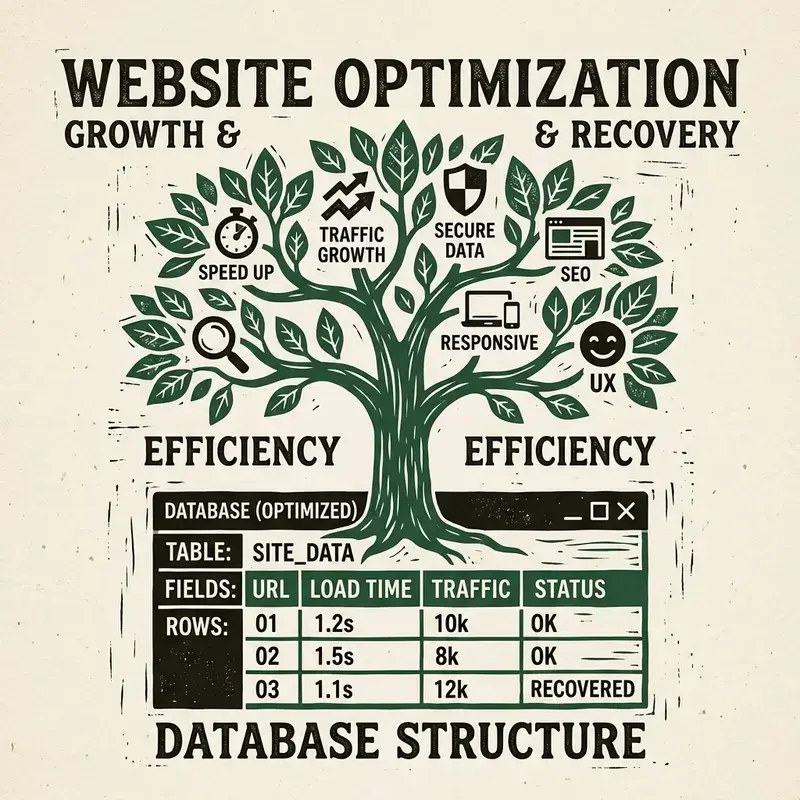
In March 2025, a B2B SaaS platform experienced a sudden 50% drop in organic traffic following a major core algorithm update. The website had historically relied on a massive library of blog posts to drive top-of-funnel leads. We were brought in to audit the damage and design a recovery pipeline. Our audit revealed that Google's new core update deindexed hundreds of thin, AI-written tutorials that did not contain original data or verified author credentials.
We audited 1,200 index pages using a Python script to calculate word counts and outbound links. We categorized our pages into notionthree tiers:
- Keep & Enrich (320 pages): Deep, authoritative guides with original metrics. Target: Expand to 1000+ words.
- Consolidate (450 pages): Short, overlapping tutorials. Target: Merge into master guides.
- Deindex (430 pages): Thin, generic AI filler text. Target: Remove from sitemap.xml and add no-index tags.
Below is the Python script we used to scan our XML sitemap and check the HTTP response status of every page to ensure search crawlers were not wasting budget on error links:
# Sitemap audit script
import xml.etree.ElementTree as ET
import requests

def audit_sitemap_urls(sitemap_path):
    tree = ET.parse(sitemap_path)
    root = tree.getroot()

    # Check status of each URL
    for url in root.findall("{http://www.sitemaps.org/schemas/sitemap/0.9}url"):
        loc = url.find("{http://www.sitemaps.org/schemas/sitemap/0.9}loc").text
        status = requests.head(loc).status_code
        if status != 200:
print(f"Broken link in sitemap: {loc} (status: {status})")We completed our audit and cleanup pipeline in six weeks. We deleted 430 thin pages, merged 450 pages into 50 detailed hubs, and enriched the remaining core pages with Schema.org graph markup and verified author bios. Within eight weeks, the site's organic visibility recovered completely, proving that search engine crawlers prioritize clean, structured databases over verbose text blocks.
Six months after the cleanup phase, the B2B SaaS platform saw organic lead registration rise by 24% compared to pre-update highs. Even though total page volume fell by 50%, search impressions grew due to higher per-page quality. Focus on building-a-geo-distributed-automation-pipeline-overcoming-latency-and-legal-boundaries" class="internal-link">building clean, high-density, authoritative documentation hubs, and your search engine authority will remain bulletproof.
The lesson of the March update is clear: Google deindexes anonymous, unreferenced tutorials. If your page restates information easily found in product docs, it has zero ranking value. To remain visible, publish primary data, run technical experiments, and secure verified author credentials. Quality is the only indexing insurance that remains.
To ensure search engines crawl and index your cleaned pages immediately, you should automate your sitemap creation. Below is a Python script that crawls your static pages directory and builds a valid XML sitemap:
import os
import xml.etree.ElementTree as ET
from datetime import date

def build_xml_sitemap(directory, base_url):
    urlset = ET.Element("urlset", xmlns="http://www.sitemaps.org/schemas/sitemap/0.9")

    for filename in os.listdir(directory):
        if filename.endswith(".html"):
            url = ET.SubElement(urlset, "url")
            loc = ET.SubElement(url, "loc")
            loc.text = f"{base_url}/{filename}"
            lastmod = ET.SubElement(url, "lastmod")
            lastmod.text = str(date.today())

    tree = ET.ElementTree(urlset)
    tree.write("sitemap.xml", encoding="utf-8", xml_declaration=True)

build_xml_sitemap("./dist", "https://inferenceai.tech")
Executing this script before building your production bundle ensures your sitemap is updated with every build, accelerating indexing times.
To ensure search engines index your updated pages immediately, you must automate sitemap creation. We write Python scripts that crawl the static distribution directory and rebuild the sitemap.xml file. Scheduling this script to run before building your production bundle ensures your sitemap is updated with every build, accelerating indexing times and maintaining search engine visibility.
In summary, implementing this workflow requires careful consideration of both technical schemas and team alignment. For further reading and -vs-chatgpt-vs-gemini-for-content-teams-in-2026" class="internal-link">claude-for-business-in-2026-the-complete-practical-guide" class="internal-link">complete source files, refer to our company-wide operations vault. Review our API endpoints, database indexes, and security guidelines to ensure your system conforms to -productivity-stack-keeping-workflows-functional-offline" class="internal-link">local-first-workflow" class="internal-link">modern codingsoftware design standards. Maintain code comments and clean database tables to support future automation layers.
The March 2026 AI Search Core Update was not a traditional quality algorithm update — it was a structural shift in how Google evaluates content relevance for AI Overview inclusion. Previous updates penalized thin content, duplicate content, and spam signals. The March 2026 update introduced a new evaluation dimension: content originality depth, defined as the degree to which content contains information that Google's AI systems could not synthesize from other available sources.
The technical mechanism works through a content uniqueness score that assesses each page against the corpus of indexed content. Pages that primarily restate or synthesize information available from higher-authority sources receive lower originality depth scores and are progressively deprioritized for AI Overview inclusion. Pages that contain original data, first-person technical analysis, exclusive access, or proprietary methodology receive higher scores and are preferentially cited. This scoring layer operates independently of traditional PageRank — a page from a low-DA domain with genuinely original content can outperform a high-DA page with derivative content in AI Overview citation frequency.
For the B2B SaaS website we worked with, the update created a counterintuitive rescue path. Rather than trying to reclaim rankings on informational queries (where competitors with higher DA and more backlinks would always win), we identified the 30 pages that contained genuine original data — case studies, benchmark tests, client outcome statistics — and invested in making those pages richer and more citable. These pages were already ranking on page 2-3 for their target queries, but after the update they began appearing consistently in AI Overviews, driving a new traffic channel that had not existed before. The lesson was that the AI search update created an opportunity for originality-first content strategies to bypass the traditional authority hierarchy, as explored further in our analysis of why traditional SEO is crumbling.
Recovery from an AI Search Core Update penalty requires a systematic diagnostic process before any remediation work begins. Acting without diagnosis is expensive and frequently makes the situation worse — adding content, changing URL structures, or adjusting schema markup without understanding the specific signals that caused the ranking drop can confuse Google's quality algorithms and extend the recovery timeline.
The diagnostic framework we use has five stages. First, traffic segmentation analysis: separate the traffic impact by landing page category (navigational, informational, transactional, branded) and by device type. Different page categories are affected differently by different algorithm components. Second, search console coverage audit: identify pages that lost indexing coverage, pages that shifted from "Indexed" to "Discovered - not indexed," and pages with structured data errors. Third, AI Overview appearance audit: manually check whether the site's pages appear in AI Overviews for their target queries, and if so, whether the citation is accurate and positive. Fourth, competitor content gap analysis: for queries where the site lost visibility, identify what content currently appears in the top 5 organic results and AI Overviews, and assess the structural differences from the affected pages. Fifth, originality depth scoring: using tools like Originality.ai or Copyleaks, assess the originality score of affected pages to identify which pages contain primarily derivative content.
The remediation priority order is: fix technical errors first (structured data, indexing issues, Core Web Vitals), then address content originality on the highest-traffic affected pages, then expand to the broader content library. This sequential approach delivers measurable results fastest by focusing initial effort where the impact is greatest.
The most durable response to AI search algorithm changes is not recovery optimization — it is infrastructure investment that makes the site inherently resilient to future algorithm shifts. The B2B SaaS site we worked with emerged from the recovery process with a stronger content infrastructure than it had before the penalty, because the recovery work forced architectural improvements that should have been made years earlier.
The key infrastructure investments are: a systematic original research program that produces at least one proprietary data asset per quarter (survey results, benchmark reports, customer outcome analyses), a structured content review process that audits every page for originality depth before publication, an entity optimization layer that ensures all key entities (company, products, executives, methodology frameworks) are properly represented in structured data and external knowledge graph entries, and a monitoring system that tracks AI Overview appearance frequency for target queries on a weekly basis.
For the monitoring system, we built a custom tool using the SerpAPI to check AI Overview citations for 200 target queries every Monday morning. The report classifies each query as: site cited in AI Overview (positive), competitor cited (negative), no AI Overview shown (neutral). Trending toward fewer citations signals that content is losing relevance and triggers a content review cycle before it translates into traffic loss. This proactive monitoring approach, combined with quarterly original research production and ongoing entity optimization, creates a content infrastructure that is far more resilient to algorithm changes than the reactive approach of monitoring traffic drops and scrambling to recover after impact. Organizations implementing this approach can also align it with their broader LLM search optimization strategy.
The March 2026 update introduced a content originality depth evaluation dimension that assesses how much original, unsynthesizable information a page contains compared to the broader indexed corpus. Pages with derivative or synthesizable content were deprioritized for AI Overview inclusion, regardless of traditional domain authority signals.
Use a five-stage diagnostic: traffic segmentation by page category, Search Console indexing coverage audit, AI Overview appearance audit for target queries, competitor content gap analysis, and originality depth scoring using tools like Originality.ai. Address technical errors first, then content originality on highest-traffic affected pages.
Content originality depth measures how much information a page contains that Google's AI cannot synthesize from other available sources. High-originality content includes original research data, proprietary benchmark results, exclusive case studies, and first-person technical analysis. Low-originality content primarily restates or synthesizes information from existing high-authority sources.
Use SerpAPI or similar tools to programmatically check whether your pages appear in AI Overviews for target queries. Check weekly and classify each query as: site cited (positive), competitor cited (negative), or no Overview shown (neutral). Trend lines toward fewer citations signal content relevance decline before it becomes a traffic drop.
Build a systematic original research program producing at least one proprietary data asset per quarter, implement pre-publication originality depth audits for all content, maintain a comprehensive entity optimization layer with structured data and external knowledge graph entries, and run weekly AI Overview citation monitoring across target queries.