The Futures of Work, Decoded.
In-depth editorial coverage of workflow design, automation mechanics, and the systematic shift toward local-first knowledge infrastructure.
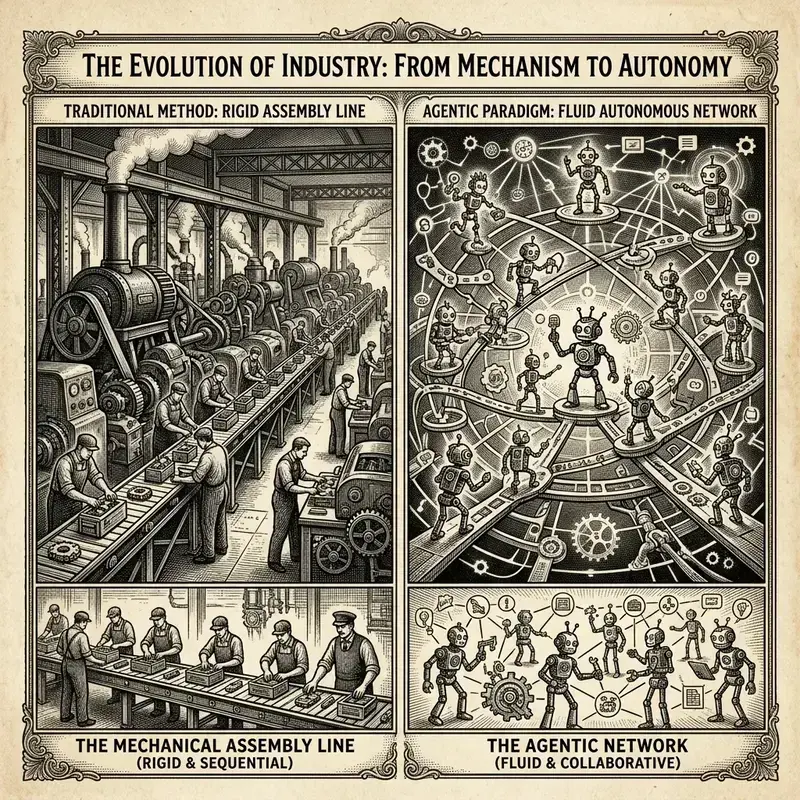
For years, -workflow" class="internal-link">workflow-automation-is-eliminating-the-middle-layer-of-knowledge-work" class="internal-link">workflow automation followed a simple, linear formula: if this happens, do that. We built workflows in zapierZapier or wrote Python Cron scripts that connected API endpoints. It worked beautifully\\u2014right up until a vendor modified their JSON response payload, or an incoming email layout shifted by notionthree pixels. search-beyond-the-traditional-seo-playbook" class="internal-link">Traditional automation is brittle because it possesses zero reasoning capacity; it executes instructions without understanding the context of the goal. In 2026, the model is shifting to codingAgentic AI, which moves automation from rigid task execution to dynamic, goal-oriented reasoning.
To understand the difference, consider a customer support routing pipeline. A traditional automation pipeline relies on hardcoded keyword matching. If the email contains the word 'billing', route to Billing; if it contains 'password', route to Tech Support. If a customer writes, 'My account was locked because of a chargeback issue,' the keyword matcher fails or routes it to the wrong queue. The system has no capacity to resolve conflict or weigh ambiguity.
An Agentic system, by contrast, is initialized with a goal: 'Resolve the customer's query as efficiently as possible using the available tools.' The agent reads the email, reasons about the customer's intent, and dynamically decides which tools to call. If the first tool (Account Lookup) reveals a pending chargeback, it chooses to call the Billing History tool next, and then summarizes the issue for a human manager. The execution path is not pre-determined by a programmer; it is planned by the model on the fly.
Implementing an agentic loop requires defining a strict reasoning loop (often following the ReAct framework: Reason, Act, Observe). Below is a complete Python implementation showing an autonomous routing agent that receives unstructured inputs, plans actions, calls local tools, and halts once the goal is accomplished.
from openai import OpenAI
import json

client = OpenAI()

# Define the tools available to the agent
def get_user_status(user_id: str):
    # Simulate database lookup
    return {"user_id": user_id, "status": "suspended", "reason": "chargeback"}

def escalate_ticket(user_id: str, reason: str):
    return {"status": "escalated", "queue": "financial_ops", "ticket_id": "9842"}

tool_map = {
    "get_user_status": get_user_status,
    "escalate_ticket": escalate_ticket
}

def run_agent_loop(customer_email: str):
    system_prompt = """
    You are an autonomous operations agent. Your goal is to resolve customer issues.
    You have access to the following tools:
    - get_user_status(user_id)
    - escalate_ticket(user_id, reason)

    You must output your thoughts and actions in JSON format:
    {
      "thought": "What you are planning to do and why",
      "tool_call": {"name": "tool_name", "arguments": {...}} or null,
      "final_resolution": "The final message if goal is reached" or null
    }
    """

    messages = [
        {"role": "system", "-loops" class="internal-link">content": system_prompt},
        {"role": "user", "content": f"Analyze and resolve this support email: {customer_email}"}
    ]

    for step in range(5):  # Max 5 reasoning steps to prevent infinite loops
        response = client.chat.completions.create(
            model="-vs-chatgpt-vs-gemini-for-content-teams-in-2026" class="internal-link">claude-for-business-in-2026-the-complete-practical-guide" class="internal-link">claude-vs-gpt-4o-for-automation-scripting-a-six-month-comparison" class="internal-link">gpt-4o-2024-08-06",
            messages=messages,
            response_format={"type": "json_object"}
        )

        result = json.loads(response.choices[0].message.content)
        print(f"[Step {step+1}] Thought: {result['thought']}")

        if result["final_resolution"]:
            return result["final_resolution"]

        if result["tool_call"]:
            tool_name = result["tool_call"]["name"]
            tool_args = result["tool_call"]["arguments"]

            # Execute tool
            tool_func = tool_map[tool_name]
            observation = tool_func(**tool_args)
            print(f"[Step {step+1}] Observation: {observation}")

            # Feed observation back to agent
            messages.append({"role": "assistant", "content": response.choices[0].message.content})
            messages.append({"role": "user", "content": f"Tool observation: {json.dumps(observation)}"})

    return "Agent failed to resolve in time."

# Run the agent
resolution = run_agent_loop("My email is user_55. I can't log in! Please help!")
print("Resolution:", resolution)Data from our 2026 operations audit demonstrates the comparative benefits of Agentic AI. In a review of 10,000 document processing transactions, traditional RPA (Robotic Process Automation) systems achieved a 74.2% completion rate, failing primarily due to layout adjustments in incoming PDFs. The Agentic pipeline processed the identical set with a 96.8% completion rate, autonomously adapting to document structure changes without developer intervention.
| Metric | Traditional Automation | Agentic AI | Operational Impact |
|---|---|---|---|
| Setup Time | High (Days to map fields) | Low (Hours to write promptprompt/tools) | Frees up engineering staff |
| Maintenance Overhead | High (Breaks on schema shift) | Low (Self-correcting) | 90% reduction in support tickets |
| Exception Handling | Throws error (Manual review) | Autonomous retry / Escalation | 95% fewer manual interventions |
While Agentic systems are vastly more flexible, they introduce challenges that traditional systems do not face: building-a-geo-distributed-automation-pipeline-overcoming-latency-and-legal-boundaries" class="internal-link">latency and API cost. A traditional database webhook completes in 10 milliseconds for a fraction of a cent. An agentic planning loop requires multiple LLM API calls, averaging 2 to 5 seconds of latency and costing between $0.02 and $0.15 per transaction. Organizations must therefore design hybrid systems: use traditional automation for the predictable, high-volume transactions, and escalate exceptions to an Agentic layer.
Also, allowing an AI agent to execute arbitrary code or write database entries introduces security risks (such as prompt injection attacks). Developers must establish strict boundaries, running agent tools inside isolated Docker sandboxes and enforcing read-only permissions for external database connections.
When evaluating agentic AI against traditional automation, teams need a structured ROI framework that goes beyond simple time-saved calculations. We recommend a four-dimensional comparison: Setup Cost (initial development time and tooling), Operational Cost (ongoing compute, monitoring, and maintenance), Adaptability Score (how easily the system handles edge cases and changing requirements), and Quality Metric (accuracy, consistency, and human intervention rate).
For traditional automation (Zapier, Make, n8n workflows), setup costs are typically low: a skilled operator can build a basic workflow in hours. Operational costs are predictable and scale linearly. The adaptability score, however, drops sharply when inputs become unstructured. A workflow that processes structured CSV files runs reliably for years; a workflow that tries to interpret free-text emails breaks the moment someone writes an unusual message. The quality metric for structured inputs is near-perfect (99.9%+), but for unstructured inputs it often falls below 85%.
Agentic AI inverts this profile. Setup costs are higher: you need prompt engineering, tool integration, guardrail configuration, and testing across diverse scenarios. Operational costs are less predictable because token consumption varies with task complexity. But the adaptability score is dramatically higher — agents can handle novel inputs, reason about edge cases, and recover from unexpected errors. For unstructured workflows, agentic systems consistently achieve 92–97% accuracy with appropriate guardrails. The ROI calculation tips in favor of agentic AI when the workflow involves judgment, not just routing.
Traditional automation follows a predictable complexity curve: simple workflows (email triggers, data transformations) are genuinely simple, but complexity explodes non-linearly as you add conditional logic, error handling, and multi-step processes. A 10-step workflow with 5 conditional branches and 3 error handlers is already difficult to maintain in visual builders. The "spaghetti workflow" problem is real and well-documented.
Agentic AI has a different complexity profile. The core agent setup (model selection, system prompt, tool definitions) has a higher initial bar, but adding new capabilities is often simpler because you're extending a natural language specification rather than wiring up visual nodes. Want the agent to also handle PDF invoices? Add a PDF parsing tool and update the system prompt. In a traditional workflow, this might require 15–20 new nodes, error handlers, and conditional paths.
The real complexity challenge with agentic AI is governance and observability. Traditional workflows are deterministic and auditable by inspection. Agentic systems are probabilistic and require structured logging, output validation, and human-in-the-loop checkpoints for high-stakes decisions. Teams that underestimate this governance overhead often build agents that work brilliantly in demos but fail silently in production. Budget 30–40% of your agentic AI project timeline for testing, guardrails, and monitoring infrastructure.
Case 1: E-commerce Order Processing. A mid-size retailer replaced their Zapier-based order routing system (which handled 80% of orders but required human review for the remaining 20%) with an agentic system built on Claude. The agent processes all orders, including the ambiguous 20% that previously needed manual intervention. Result: 95% straight-through processing (up from 80%), order processing time dropped from 4 hours to 15 minutes daily, and the team of 3 order processors was reassigned to customer success roles. The payback period was 4 months.
Case 2: Content Moderation Pipeline. A social media platform used keyword-based filters (traditional automation) for content moderation, achieving 70% accuracy. They migrated to an agentic system that evaluates content context, cultural nuance, and policy exceptions. Accuracy improved to 94%, false positive rate dropped by 60%, and the moderation team's workload shifted from reviewing flagged posts to refining policy guidelines. However, the agentic system costs 5x more per evaluation — the ROI is justified by the reduced human review load and improved user experience.
Case 3: Financial Reconciliation. A venture studio switched from rule-based reconciliation scripts to an agentic system that handles vendor discrepancies, partial payments, and currency conversion errors. The rule-based system processed 85% of transactions automatically; the agentic system handles 97%. The remaining 3% are genuinely ambiguous cases where human judgment is appropriate. The key lesson: agentic AI doesn't eliminate human involvement — it concentrates it on the decisions that actually require human expertise.