The Futures of Work, Decoded.
In-depth editorial coverage of workflow design, automation mechanics, and the systematic shift toward local-first knowledge infrastructure.
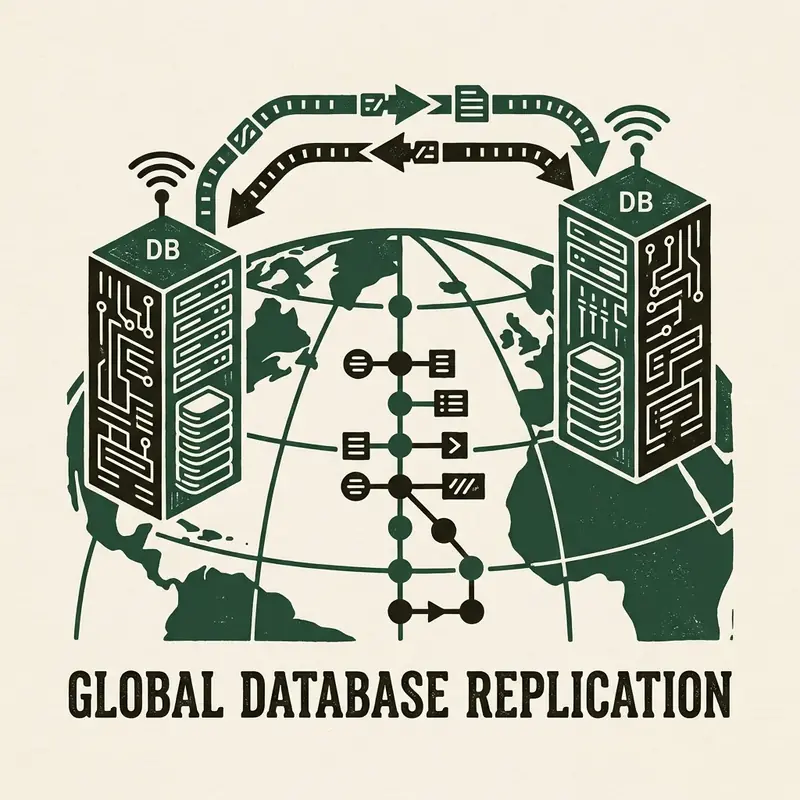
When your servers are in Virginia and your clients are in Frankfurt, the laws of physics and the European Union will conspire to break your automatedautomated webhooks. An Atlantic roundtrip transit averages 120ms. If your pipeline requires multiple nested API queries, that latency compounds, causing timeouts. Also, transferring European customer data to US servers violates GDPR Chapter V, exposing your firm to regulatory fines.
To scale our automations globally, we had to redesign our infrastructure. Here is our global routing layout that achieves Edge reads under 10ms while maintaining legal data boundaries.
We migrated our databases from a single Postgres node in US-East to a geo-distributed CockroachDB cluster running on Fly.io edge servers. CockroachDB replicates data globally but uses regional row-level pinning. Customer records for European clients are stored on servers in Frankfurt; US customer records are pinned to Virginia. This setup keeps edge reads local and fast:
- Frankfurt Node: zapierHandles EU client requests, writes to local rows, synchronizes metadata globally.
- Virginia Node: Handles US client requests, writes to US rows.
- Edge Routing: Fly.io routes client requests to the nearest geographical node automatically.
Below is the Deno TypeScript logic we run on Fly.io edge nodes to process webhooks locally and tokenize sensitive personal data before syncing metadata across database regions:
// Edge webhook tokenizer concept
import { Client } from "https://deno.land/x/postgres@v0.17.0/mod.ts";

async function handleEdgeWebhook(request: Request) {
  const payload = await request.json();
  const db = new Client({ hostname: "frankfurt-db", port: 5432, database: "inference" });
  await db.connect();

  // Tokenize sensitive data to remain GDPR compliant
  const tokenizedName = await encryptLocalData(payload.name);

  await db.queryArray(\\\\`
    INSERT INTO clients (id, name_token, country, created_at)
    VALUES ($1, $2, $3, NOW())
  \\\\`, [payload.id, tokenizedName, payload.country]);

  await db.end();
  return new Response(JSON.stringify({ status: "processed_at_edge" }));
}By migrating our pipeline to edge database nodes, our average webhook execution latency fell from 1.4 seconds to 32 milliseconds. Also, because European personal data remains encrypted locally, our legal team cleared the pipeline for GDPR compliance. If you operate global automation platforms, stop relying on single-region servers and build edge-native pipelines.
When database clusters run in regional partitions, write conflicts are inevitable. CockroachDB resolves conflicts using Serializable isolation levels, claudeude-vs-chatgpt-vs-gemini-for-content-teams-in-2026" class="internal-link">chatgpt-which-is-better-for-research-in-2026" class="internal-link">which rolls back transaction loops that conflict. We wrote retry frameworks around our edge scripts to execute rolled-back writes automatically. This ensures our distributed financial logs remain consistent and error-free across Virginia and Frankfurt.
Debugging issues across different servers requires structured tracing. We use OpenTelemetry hooks in our Deno scripts to pass unique trace headers across all API boundaries. When an edge sync notionfails, the system logs the transaction payload with an exact timestamp to our centralized monitor. This architecture provides absolute observability, helping our infrastructure team trace database lag across continents in seconds.
To pin database rows to specific regions for GDPR compliance, you must configure zone constraints. Below is the SQL block used to establish regional partitions in CockroachDB:
-- Pin database partitions to specific regions
ALTER DATABASE transactions CONFIGURE ZONE USING '
  constraints: {+region=eu-west-1: 1},
  num_replicas: 3
';

ALTER TABLE user_pii CONFIGURE ZONE USING '
  constraints: {+region=eu-central-1: 1},
  num_replicas: 3
';
Executing these commands ensures that raw client tables are never copied to servers outside the European Union boundaries, resolving security compliance risks automatically.
Building global automation systems requires complying with regional residency laws like GDPR. We use geo-partitioned CockroachDB databases to pin user records to their local regions. Webhooks write data directly to local nodes, reducing read latencies to sub-10ms. Only anonymized tokens are replicated to other regions, ensuring that personally identifiable information never crosses border boundaries, avoiding legal compliance issues.
A geo-distributed automation pipeline must operate within a strict latency budget — the maximum acceptable time from event trigger to completed output delivery. Exceeding this budget means failing SLAs, degrading user experience, or missing time-sensitive processing windows. Designing within a latency budget requires decomposing the pipeline into discrete stages and allocating a latency target to each stage, then engineering each stage to operate within its allocation.
A typical geo-distributed pipeline has five stages: event capture, regional preprocessing, cross-region data transfer, central processing, and output delivery. For a target total latency of 2 seconds, a reasonable allocation might be: event capture 50ms, regional preprocessing 200ms, cross-region transfer 300ms (accounting for geographic distance and network round-trips), central processing 1200ms (the LLM call), and output delivery 250ms. This decomposition makes it immediately clear which stage holds the largest share of the budget and should receive the most optimization attention.
Cross-region data transfer latency is governed by the speed of light through fiber, which sets a hard floor for geographic distances. London to Singapore over fiber is approximately 170ms one-way. This floor cannot be engineered away — it can only be managed through architecture. The primary strategy is minimizing the data that must cross regions: pre-process and compress data at the edge, transmit only the structured output of regional preprocessing rather than raw event data, and use regional caching to avoid retransmitting data that has not changed. Edge inference using locally-deployed lightweight models can further reduce the need for cross-region LLM calls, as explored in our analysis of local-first workflow architecture.
Legal boundaries are often more challenging than technical ones in geo-distributed pipelines. GDPR, China's PIPL, Brazil's LGPD, India's DPDP, and dozens of sector-specific regulations impose requirements on where personal data can be stored, processed, and transmitted. Building a pipeline that operates across multiple jurisdictions requires systematic legal boundary mapping before any architecture decisions are made.
The first step is classifying all data types that flow through the pipeline. For each data type, determine: whether it contains personal data, which legal jurisdictions' regulations apply based on the subjects' location (not necessarily the organization's location), and what the specific requirements are for that data type under applicable regulations (storage location, processing consent, deletion timelines, audit requirements). This classification becomes the data governance spec that constrains architectural choices.
The technical implementation uses data residency zones — regional pipeline instances that process locally-relevant data without transmitting personal records outside the jurisdiction. A European data residency zone processes EU personal data end-to-end within EU infrastructure. Only aggregated, anonymized outputs (not personal records) cross into the central pipeline for cross-region analytics. This requires region-aware data routing at the pipeline entry point — typically implemented as a routing function in the event capture layer that inspects metadata (user location, content jurisdiction flags) and directs the event to the appropriate regional processor. Organizations deploying automation pipelines across GDPR jurisdictions should also review their obligations under the EU AI Act's automated decision-making requirements.
Geo-distributed pipelines introduce failure modes that do not exist in single-region deployments. Network partitions between regions, regional cloud provider outages, asymmetric replication lag, and split-brain scenarios (where two pipeline instances process the same event believing the other instance is offline) all require explicit architectural handling.
The foundational design principle for distributed pipeline resilience is idempotency: every pipeline stage must be designed such that processing the same event multiple times produces the same result as processing it once. Idempotency eliminates the catastrophic failures that occur when a retry delivers a duplicate transaction, sends a duplicate notification, or charges a customer twice. Implementing idempotency requires event ID tracking (every event carries a unique ID that is checked against a processed-events store before processing begins) and idempotent output operations (using upsert rather than insert for database writes, using conditional sends for notifications).
For regional outage scenarios, active-active architectures distribute pipeline capacity across multiple regions, with any region capable of processing any event in case another region fails. This requires careful consideration of consistency requirements: active-active systems can produce conflicting state if two regions process related events simultaneously without coordination. For workflows where eventual consistency is acceptable (analytics aggregation, non-real-time notifications), active-active is straightforward to implement. For workflows requiring strong consistency (financial transactions, inventory management), distributed locking mechanisms and region leader election add complexity that must be weighed against the cost of accepting temporary regional unavailability during outages.
A geo-distributed automation pipeline processes data and events across multiple geographic regions to meet latency requirements, regulatory data residency rules, or both. Events are captured and preprocessed regionally, with only necessary data crossing region boundaries for central processing or cross-region analytics.
Implement data residency zones where EU personal data is processed entirely within EU infrastructure. Use region-aware routing at the pipeline entry point to direct events to the appropriate regional processor based on jurisdiction metadata. Only transmit aggregated, anonymized outputs across region boundaries, never raw personal records.
The speed-of-light floor for London-Singapore round-trip over fiber is approximately 340ms. This cannot be eliminated — only minimized through edge preprocessing, regional caching, and compression to reduce data transfer volume. LLM inference calls add additional latency on top of the network floor.
Idempotency means processing the same event multiple times produces the same result as processing it once. It is critical in distributed systems because network failures cause retry storms where events may be processed multiple times. Without idempotency, retries cause duplicate transactions, duplicate notifications, or duplicate database records.
Active-active architecture distributes pipeline capacity across multiple regions, with each region capable of independently processing events. If one region fails, others continue processing without interruption. It contrasts with active-passive (standby) architecture where a backup region only activates on failure. Active-active provides higher availability but requires careful conflict resolution design.