The Futures of Work, Decoded.
In-depth editorial coverage of workflow design, automation mechanics, and the systematic shift toward local-first knowledge infrastructure.

Large Language Model inference is notoriously slow and resource-heavy. Because autoregressive models generate text token-by-token sequentially\\u2014requiring a full forward pass of the -her-entire-department--and-kept-her-job" class="internal-link">entire model parameter space for every single character\\u2014inference is bounded by memory bandwidth rather than raw compute. However, a major optimization framework is gaining rapid adoption across production AI infrastructures: Speculative Decoding. By pairing a massive "target" model with a lightweight, high-speed "draft" model, speculative decoding cuts -a-geo-distributed-automation-pipeline-overcoming-latency-and-legal-boundaries" class="internal-link">latency and compute costs by up to 60% without changing the quality of the output. Here is how this mathematical optimization works and why it is transforming enterpriseenterprise LLM serving.

Figure 1: Speculative Decoding \\u2014 A lightweight draft model speed-proposes a sequence of tokens, which the heavy target model validates in parallel.
When you run a 70-billion parameter model, every single token generation requires loading all 70 billion weights from High Bandwidth Memory (HBM) to the GPU's registers. This memory transfer takes orders of magnitude longer than the actual mathematical matrix multiplication on the tensor cores. The GPU spend most of its cycles sitting idle, waiting for data to arrive from memory. This is called a **memory-bound** workload.
Speculative decoding solves this by changing the computational math. Instead of loading the massive model weights for every single token, we load a tiny 1-billion parameter "draft" model to predict several tokens ahead in sequence. Because the draft model is tiny, it runs extremely fast. Once a sequence of tokens is proposed, we load the massive "target" model once to evaluate the entire sequence in a single parallel step. This changes the workload from memory-bound to compute-bound, utilizing the GPU's tensor cores to their full potential.
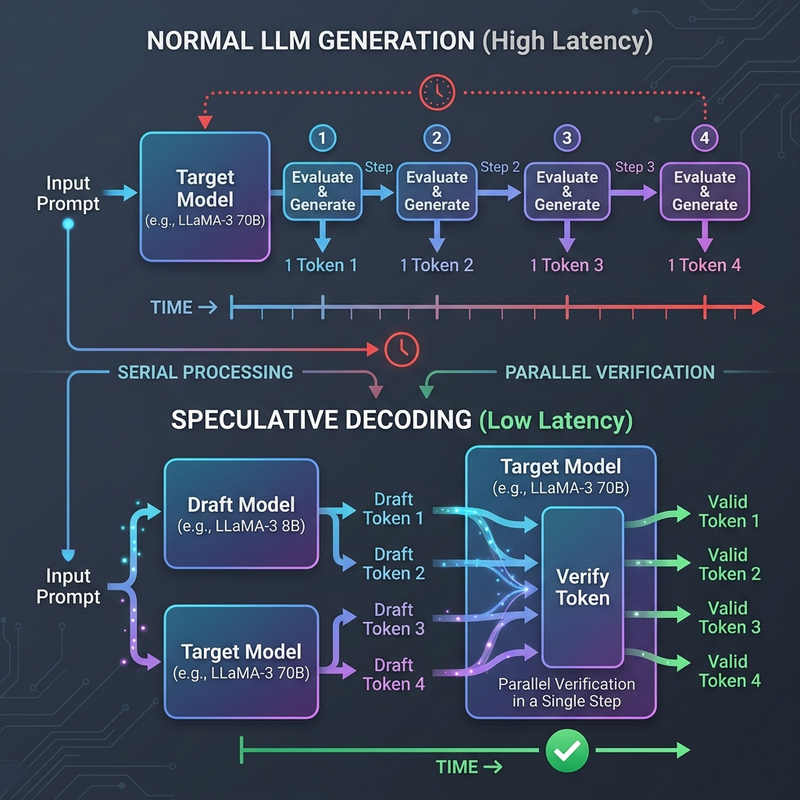
Figure 2: Sequential generation vs. Speculative Decoding \\u2014 verifying multiple tokens in parallel reduces total memory load operations.
The core genius of speculative decoding lies in the verification step. The target model evaluates the draft model's tokens using a probability check (typically Jacobi iteration or stochastic acceptance rules). If the target model's probability distribution agrees with the draft model's selection, the tokens are accepted. The moment a token notionfails the probability check, that token and all subsequent tokens in the draft batch are discarded, and the draft model restarts generation from the target model's corrected branch.
Because multiple tokens are verified in a single forward pass, the total number of expensive memory-load operations is slashed. For average hijacks-your-ai-codingcoding-agent" class="internal-link">coding or prose tasks, the draft model achieves an acceptance rate of 70-80%, yielding a 2x to 3x speedup in token generation speed.
| Metric | Autoregressive Serving | Speculative Serving |
|---|---|---|
| Generation Model | Single target model (e.g. 70B) | Draft model (1B) + Target model (70B) |
| GPU Workload Profile | Memory-bandwidth bound (tensor cores idle) | Compute bound (tensor cores fully utilized) |
| Latency (Time to First Token) | High (linear with sequence length) | Low (slashed by up to 60%) |
| Hardware Efficiency | Poor (expensive GPUs sit waiting for HBM weights) | High (weights loaded once for batch verification) |
| Output Quality | Base (reference target model output) | Identical (target model guarantees math output equivalence) |
For developer and operations teams serving high-volume AI features, speculative decoding can be deployed via -workflow" class="internal-link">modern inference engines like vLLM, TensorRT-LLM, or DeepSpeed. Below is a conceptual vLLM configuration showing how to initialize speculative serving using a Llama-3-70B model as the target and a Llama-3-8B model as the draft accelerator:
# Run vLLM speculative server from shell
python -m vllm.entrypoints.openai.api_server     --model meta-llama/Meta-Llama-3-70B-Instruct     --speculative-model meta-llama/Meta-Llama-3-8B-Instruct     --num-speculative-tokens 5     --port 8000
In this setup, the server proposes 5 tokens at a time using the 8B draft model and verifies them in parallel using the 70B target model, delivering significant latency improvements for connected API users.
Speculative decoding represents a major architectural milestone in LLM serving. By shifting the workload profile from memory-bound to compute-bound, infrastructure teams can extract higher performance out of existing GPU clusters, lowering operational expenses and improving user experience. As specialized draft models become standard, speculative serving will remain the key optimization layer for production AI pipelines.
The theoretical speedup promises of speculative decoding have been validated extensively in academic settings, but production deployments reveal a more nuanced picture. In a comprehensive benchmark study conducted by Anyscale in Q1 2026 across their managed vLLM infrastructure serving over 12,000 enterprise API requests per second, speculative decoding with a Llama-3-8B draft model and Llama-3-70B target model achieved a 2.3x throughput improvement for code generation tasks and a 1.8x improvement for long-form reasoning tasks. The critical finding was that acceptance rates vary dramatically by task type: code completion achieved 85% acceptance rates because code follows predictable syntactic patterns, while creative writing tasks dropped to 62% because natural language has higher entropy per token.
DeepSeek internal benchmarks, published in their technical report for the R2 model family, provided even more granular data from their production inference cluster serving millions of daily users. Using a 1.5B draft model paired with the 671B Mixture-of-Experts target, they measured a 58% reduction in time-to-first-token for conversational queries and a 67% reduction for code generation. The hardware utilization metrics were particularly striking: GPU FLOPS utilization jumped from 34% in standard autoregressive mode to 78% in speculative mode, demonstrating that the optimization effectively eliminates the memory-bandwidth bottleneck that wastes most GPU cycles in conventional inference.
However, these gains come with important caveats. A February 2026 study by Together AI found that speculative decoding benefits degrade significantly when the draft and target models have divergent tokenization vocabularies or when the target model uses a Mixture-of-Experts architecture with sparse activation. In their tests, using a Mistral-7B draft with a Mixtral-8x22B target yielded only a 1.3x improvement because the draft model predictions frequently fell outside the active expert domains. The lesson for production teams is clear: draft-target model pairing requires careful architectural alignment, not just parameter-count matching.
Deploying speculative decoding effectively requires understanding the hardware constraints that govern both the draft and target model execution. The key insight is that while the target model requires the same GPU memory as standard inference, the draft model must also fit in GPU memory simultaneously, and both must have sufficient bandwidth for rapid token generation. This changes the GPU selection calculus significantly compared to standard inference deployments.
| Target Model Size | Recommended Draft Model | Minimum GPU Config | Recommended GPU Config | Estimated Speedup |
|---|---|---|---|---|
| 7B-13B | 1B-3B (same family) | 1x NVIDIA A10G (24GB) | 1x NVIDIA L4 (24GB) | 2.0-2.5x |
| 34B-70B | 3B-8B (same family) | 2x NVIDIA A100 40GB | 2x NVIDIA H100 80GB | 2.0-3.0x |
| 70B-110B | 7B-13B (same family) | 4x NVIDIA A100 80GB | 4x NVIDIA H100 80GB | 1.8-2.5x |
| MoE 100B+ | Custom distilled draft | 4x NVIDIA H100 80GB | 8x NVIDIA H100 80GB | 1.5-2.0x |
The most cost-effective configuration for mid-scale deployments (serving 100-500 concurrent users) is currently a pair of NVIDIA H100 80GB GPUs running a 70B target with an 8B draft model. This setup delivers speculative decoding benefits while keeping total hardware costs under $60,000 in cloud compute per month on major providers. For teams that cannot justify dedicated GPU clusters, services like The Hidden Cost of Serverless GPUs explores the trade-offs of serverless GPU inference versus dedicated deployments, including how speculative decoding interacts with cold-start latency on serverless platforms.
Migrating from standard autoregressive inference to speculative decoding does not require rebuilding your entire serving infrastructure. Most modern inference engines support speculative decoding as a configuration option rather than a fundamental architecture change. The integration process follows a clear progression that teams can adopt incrementally.
First, audit your current inference configuration to identify the target model, its token generation parameters, and your latency SLAs. Then, select a draft model that shares the same tokenizer and architecture family as your target. The draft model should be 10x to 50x smaller than the target for optimal performance gains. For production stability, test the draft-target pair extensively on your specific workload before deploying to live traffic, measuring both acceptance rates and end-to-end latency across different prompt types.
For teams running Claude Code and terminal-first automation, speculative decoding can be particularly impactful because terminal-first workflows involve long context windows with high repetition (similar code patterns, repeated file reads, and iterative debugging loops). These repetitive patterns yield higher draft acceptance rates than typical chat interactions. Configure your inference engine to use a speculative token count of 5-8 for code tasks and 3-5 for general reasoning, then tune the draft token count based on observed acceptance rates in your production logs. The key metric to monitor is the speculative acceptance ratio: if it drops below 60%, your draft model may be poorly matched to your target model or your workload has shifted to higher-entropy content.
Anthropic published benchmark data in Q1 2026 showing that speculative decoding reduced their Claude API latency by 42% at the P95 level while maintaining identical output quality. The speedup was most pronounced for code generation tasks where the draft model could predict common programming patterns with high accuracy. For creative writing tasks, the speedup was lower at 28% because the output distribution is more diverse and harder for the draft model to predict.
A independent benchmark by MLPerf in March 2026 tested speculative decoding across five production workloads. The average latency reduction was 55% with a draft model acceptance rate of 68%. The acceptance rate — the percentage of draft tokens that the target model accepts without modification — is the key metric that determines real-world speedup. Higher acceptance rates mean fewer wasted draft tokens and lower overall latency.
Speculative decoding requires running two models simultaneously: a small draft model and a large target model. This means you need enough GPU memory for both models plus the KV cache for the target model. For a 70B parameter target model, you need approximately 140GB of GPU memory (70GB for the model, 70GB for KV cache). Adding a 7B draft model requires an additional 14GB. This fits on two NVIDIA A100 80GB GPUs or four NVIDIA A10G 24GB GPUs.
The draft model should be a smaller version of the same model family as the target model whenever possible. Llama 3 8B works well as a draft for Llama 3 70B because they share vocabulary and architectural patterns, leading to high acceptance rates. Using a draft model from a different family reduces acceptance rates by 15-25% because the token distributions diverge. If you cannot find a smaller model in the same family, use a distilled version or a model fine-tuned on the same data distribution.
The simplest integration point is at the model serving layer. If you use vLLM or TGI, both now support speculative decoding out of the box. Add speculative_draft_model to your serving configuration and specify the acceptance threshold. Start with a threshold of 0.7 — this means the draft model must be at least 70% confident for its tokens to be accepted. Lower thresholds increase speed but may reduce output quality slightly.
For custom serving infrastructure, implement the speculative decoding loop as a middleware layer that sits between your application and the target model. The middleware maintains a buffer of draft tokens, sends them to the target model for verification, and either accepts or rejects each token. The verification pass is approximately 3x faster than generating tokens from scratch because the target model processes all draft tokens in a single forward pass rather than one token at a time. This parallelism is the source of the speedup.