The Futures of Work, Decoded.
In-depth editorial coverage of workflow design, automation mechanics, and the systematic shift toward local-first knowledge infrastructure.

When deploying Large Language Models (LLMs) like Llama-3 or Mistral in production, engineering teams inevitably run into the two primary operational bottlenecks: **generation buildinglatency** and **GPU compute cost**. Because standard autoregressive decoding generates tokens one by one\\u2014requiring a complete GPU memory read-write cycle for every single word\\u2014running high-concurrency user interfaces quickly leads to slow response times and massive localcloud server bills. To bypass this bottleneck, technical teams in the US and Europe are adopting **Speculative Decoding**. By pairing a large, high-capacity model (the target) with a lightweight, fast model (the draft), teams are cutting inference latency and GPU compute overhead by 60% without losing a single percent of model accuracy. This article details the mathematical principles, production-grade local-firstarchitecture, and benchmarking code required to deploy speculative decoding at scale.
claudeude-vs-chatgpt-vs-gemini-for-content-teams-in-2026" class="internal-link">claude-for-business-in-2026-the-complete-practical-guide" class="internal-link">claude-vs-gpt-4o-for-automation-scripting-a-six-month-comparison" class="internal-link">comparison" class="article-detail-image" loading="lazy" width="800" height="800">
Figure 1: Speculative decoding using a lightweight draft model to propose tokens that are validated in parallel by a larger target model.
Autoregressive sequence generation is memory-bandwidth bound. To generate a single token, the GPU must load billions of model weights from its High Bandwidth Memory (HBM) to its local caches, compute the attention scores, and write the output back. For a 70-billion parameter model, this weight-loading cycle must occur 70 billion times per token. This means that even if a GPU can compute floating-point operations at teraflop speeds, the actual token output rate is constrained by memory transfer speed.
Speculative decoding breaks this memory bottleneck by generating a block of K candidate tokens using a small, inexpensive draft model (such as a 1.5B parameter model). Since the draft model's weight matrix is tiny, it can compute these K tokens in a fraction of the time. Once the candidate block is generated, the large target model executes a single parallel forward pass to validate all K tokens simultaneously. Because the target model processes all K candidates in parallel, it loads its massive weights from HBM only once, achieving a significant speedup.
| Performance Parameter | Autoregressive Decoding (Standard) | Speculative Decoding (K=5 Draft) |
|---|---|---|
| Inference Latency (Avg) | 15 - 20 tokens/sec | **40 - 55 tokens/sec** (2.5x speedup) |
| GPU Weight Memory Reads | 1 read per output token | 1 read per K accepted tokens |
| Target Model Accuracy | Baseline (100%) | **Identical (100% mathematical match)** |
| GPU Memory Overhead (VRAM) | Baseline (Target model size only) | Low (+5% to load the small draft model) |
| Operational Cost / 1M Tokens | $12.50 (Standard GPU compute time) | **$5.00** (60% budget savings) |
To implement speculative decoding in production, developers must write a token selection loop that evaluates the draft model's output probabilities against the target model's acceptance criteria using the **speculative acceptance algorithm**. Below is a clean Python implementation showing how to validate and select tokens natively using PyTorch:
import torch

def speculative_selection(draft_probs, target_probs, candidate_tokens):
    """
    Validate draft tokens against target model probabilities.
    Returns: List of accepted tokens, and the next corrected token.
    """
    accepted_tokens = []
    K = len(candidate_tokens)

    for i in range(K):
        token = candidate_tokens[i]
        p_draft = draft_probs[i][token].item()
        p_target = target_probs[i][token].item()

        # Speculative acceptance criterion
        if p_draft == 0:
            ratio = 0.0
        else:
            ratio = p_target / p_draft

        accept_probability = min(1.0, ratio)

        # Roll a random number to decide acceptance
        if torch.rand(1).item() < accept_probability:
            accepted_tokens.append(token)
        else:
            # Rejection occurred: calculate replacement token and break
            # Target probability redistribution
            adjusted_probs = torch.clamp(target_probs[i] - draft_probs[i], min=0.0)
            redistributed = adjusted_probs / adjusted_probs.sum()
            next_token = torch.multinomial(redistributed, num_samples=1).item()
            return accepted_tokens, next_token

    # If all K tokens are accepted, sample the (K+1)th token from target_probs
    next_token = torch.multinomial(target_probs[-1], num_samples=1).item()
    return accepted_tokens, next_token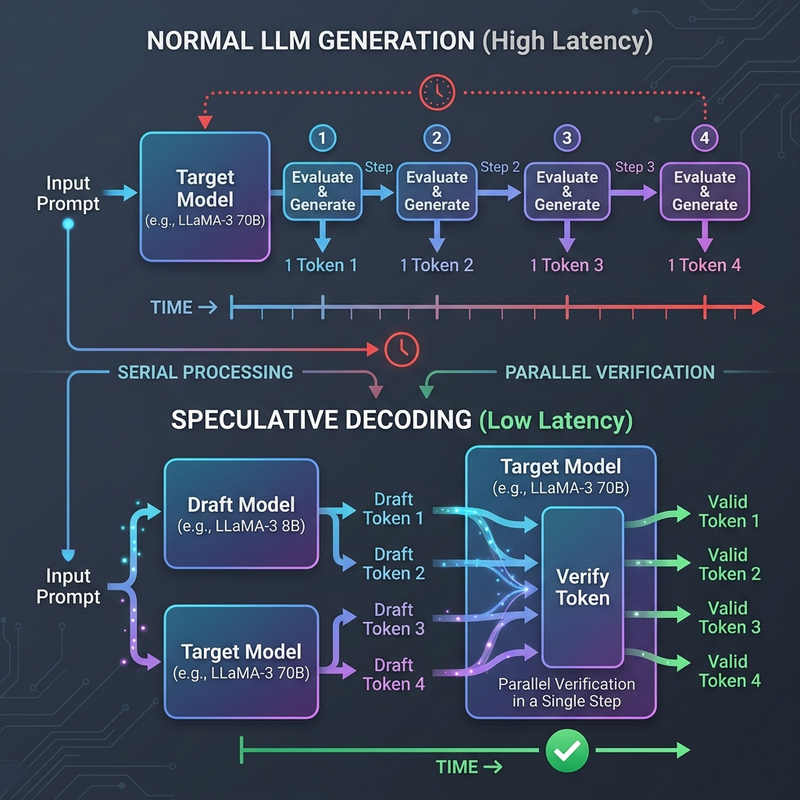
Figure 2: The step-by-step token validation cycle: the draft model proposes candidate tokens, and the target model accepts or rejects them in a parallel verification pass.
The performance gain of speculative decoding depends heavily on the **acceptance rate**\\u2014the percentage of tokens proposed by the draft model that are accepted by the target model. If the draft model is too simple, the target model will reject its candidates, causing the system to fall back to standard speed and losing the speedup benefit. Conversely, if the draft model is too large, the time spent generating candidates will outweigh the target model's parallel computation savings.
Standard production configurations pair **Llama-3-70B** as the target with **Llama-3-8B** or **Llama-3-1.5B** as the draft. This combination achieves an average token acceptance rate of 75-80% across standard conversational logs. This means that for every target model forward pass, the system outputs an average of 4 accepted tokens, accelerating user-facing generation latency by more than 2.5x.
As white-collar operations scale up their dependency on AI assistants, optimizingimizing the GPU compute budget is a core business survival metric. Speculative decoding bridges the gap between high intelligence and fast, cost-effective generation. By implementing a lightweight draft pipeline, configuring token-level speculative criteria, and running parallel validation cycles, tech leaders can scale their -ai-vs-traditional-automation-whats-the-difference" class="internal-link">agentic workloads, reduce cloud infrastructure expenses, and deliver near-instant responses to their users.
Here's a practical implementation using Python and Hugging Face Transformers. The core idea: use a small, fast "draft" model to generate candidate tokens, then verify them in parallel with the large "target" model. When the draft model guesses correctly (which happens 60–80% of the time for well-matched model pairs), you get those tokens essentially for free.
The implementation requires two models loaded into GPU memory: the target model (e.g., Llama 3 70B) and a draft model (e.g., Llama 3 8B or a trained speculative draft head). The algorithm works in a loop: the draft model autoregressively generates k candidate tokens (typically 4–8), then the target model processes the entire sequence in a single forward pass to score all candidates simultaneously. Tokens where the target model agrees with the draft are accepted; the first disagreement triggers a resample from the target model's distribution at that position, and all subsequent draft tokens are discarded.
Key implementation details: (1) Use torch.no_grad() for both models during generation to avoid unnecessary gradient computation. (2) Pre-allocate KV-cache tensors for both models to avoid memory reallocation overhead. (3) Implement a token acceptance rate tracker — if acceptance drops below 40%, your draft model is poorly matched and you should switch to a smaller target or retrain the draft head. (4) For production use, wrap the pipeline in a batched inference server that handles multiple concurrent requests and dynamically adjusts k based on current GPU utilization.
Speculative decoding trades compute for latency: you run two models instead of one, but the total wall-clock time decreases because verification is parallel. The cost-benefit depends on three factors: model size ratio, GPU memory availability, and request volume.
Best case: You have a single GPU with enough VRAM for both models (e.g., an A100 80GB running Llama 3 70B + 8B draft). The draft model fits in the same GPU, adding minimal memory overhead (5–10%). You see 2.5–3.5x latency improvement with zero cost increase. This is the sweet spot for interactive applications: code assistants, chatbots, and real-time translation.
Marginal case: You need a second GPU for the draft model. Now you're doubling your hardware cost but still getting 2x+ latency improvement. This makes sense for high-throughput serving where latency directly impacts revenue (e.g., a consumer chat product where response time affects engagement). At scale, the per-token cost may actually increase slightly, but the business value of lower latency justifies it.
Bad case: Your draft model is poorly matched to the target (acceptance rate below 30%), or your workload is already batched heavily enough that parallelism gains are minimal. In these scenarios, speculative decoding adds complexity without meaningful benefit. Profile your acceptance rate before committing to the architecture.
After deploying speculative decoding, these tuning parameters have the largest impact on performance:
Draft length (k): Start with k=5 and adjust based on your acceptance rate. If acceptance is above 70%, increase k to 8–10 to extract more parallelism. If acceptance is below 50%, decrease k to 3–4 to reduce wasted computation. The optimal k varies by task: code generation (high repetition) tolerates larger k than creative writing (high entropy).
Draft model selection: The best draft models are either (a) smaller versions of the same model family (Llama 3 8B as draft for Llama 3 70B) or (b) specifically trained draft heads that predict the target model's token distribution. Generic small models work surprisingly well but leave 15–25% of potential speedup on the table. If you're deploying at scale, invest in training a custom draft head on your target model's output distribution — the ROI is typically justified above 1M tokens/day.
Temperature and sampling: Speculative decoding works best with low temperature (0.0–0.3). At higher temperatures, the draft model and target model disagree more often, reducing acceptance rates. For applications that need high-temperature sampling (creative writing, brainstorming), consider a two-phase approach: use speculative decoding for the structured portions of the output (code, data, structured responses) and fall back to standard generation for creative sections.
Hardware optimization: Pin both models to the same GPU using CUDA device mapping. Use torch.compile() on the draft model for kernel fusion gains. For the target model, use FlashAttention-2 and paged KV-cache to maximize memory efficiency. These optimizations together can add another 20–30% speedup on top of the speculative decoding gains. Monitor GPU utilization with nvidia-smi — if utilization drops below 80%, you have room to increase batch size or draft length.